

A package that is “not moving” is almost always doing one of two things: physically traveling between scan points without generating updates, or genuinely sitting still because something interrupted it. Tracking pages cannot tell you which — the same frozen status covers both. What you can do is compare the silence against what is normal for that carrier, and act the moment it crosses the line.
The single most useful test: has the estimated delivery date passed? Before that date, a quiet tracking page is usually just a scan gap. After it, the odds shift toward a real problem, and waiting longer rarely helps.
How long a tracking gap stays normal, by carrier
Carriers scan packages at pickup, at major sort facilities, and at delivery — not at every stop in between. A cross-country ground shipment can legitimately ride a truck for a day or more between scans. That is why the “normal” window varies so much:
| Carrier | Normal quiet period | Worth acting after |
|---|---|---|
| UPS (Ground) | Up to 24-48 hours between scans | Delivery date missed, or an unresolved exception |
| FedEx (Ground/Home) | More than 24 hours is common mid-route | 1 full day past the delivery estimate |
| USPS | 2-3 days, especially over weekends and in rural areas | Expected delivery date passes with no movement |
| DHL Express | Rarely more than 24 hours | 48 hours with no new scan |
| DHL eCommerce | 3-4 days between milestones | About 5 business days of silence |
Weekends stretch all of these. USPS moves limited volume on Sundays, FedEx Ground does not scan much on weekends, and DHL Express largely pauses in the US. A package that went quiet Friday evening often “wakes up” Monday night.
First, figure out which situation you’re in
Not-moving packages fall into four states, and the right response is different for each:
- Label created, never scanned. The status still says “Shipment Information Received,” “Label Created,” or “Pre-Shipment.” The carrier does not have the package yet — or it was handed over without an acceptance scan. This is a seller problem before it is a carrier problem.
- Moving with gaps. Scans exist but stopped a day or two ago, and the delivery estimate has not passed. This is the state most searches about stuck packages resolve to, and the answer is genuinely to wait out the window in the table above.
- Stalled after arrival at a facility. The last scan says “Arrived at Facility” and nothing has happened since. Mis-sorts and overflow backlogs live here. Give it the carrier’s normal window, then escalate — a package that missed its outbound truck usually catches the next one, but one buried behind a conveyor does not scan itself.
- Exception on record. The tracking shows a delivery exception — weather, damaged label, wrong address, customs. Stop waiting. Exceptions name the problem, and most of them need something from you or the sender to clear.
If the status wording itself is the confusing part — “In Transit, Arriving Late,” “Departed Facility,” “On the Way” — the tracking status glossary translates each one and tells you whether it needs action.
Why packages sit still (when they actually are sitting still)
The genuine causes, roughly in order of how often they happen:
- Facility backlog. Peak volume, short staffing, or weather closes the gap between “arrived” and “departed” scans. Most backlogged packages move within 24-72 hours without anyone doing anything.
- Missed or unreadable scans. A torn or smudged barcode stops generating events even while the box keeps moving. These packages often jump straight to “Out for Delivery” or “Delivered” with no warning.
- Mis-sort. The package rode the wrong truck and has to loop back. This is also the usual explanation when tracking appears to move backward or bounce between two cities — the network is correcting a routing error, not losing your box.
- Customs holds. For international shipments, silence after “Processed Through Facility” or an arrival at a gateway usually means clearance is in progress. If duties or paperwork are the issue, the status eventually flips to a clearance delay and, often, a duty request you’ll need to pay before it moves.
- Genuinely lost. Rare, and almost never announced. A shipment with no scans for more than a week, past its delivery estimate, with no exception on record, is the profile of a lost package.
What to do, carrier by carrier
Once the normal window has passed, escalate with the process built for that carrier — generic “contact support” advice wastes days:
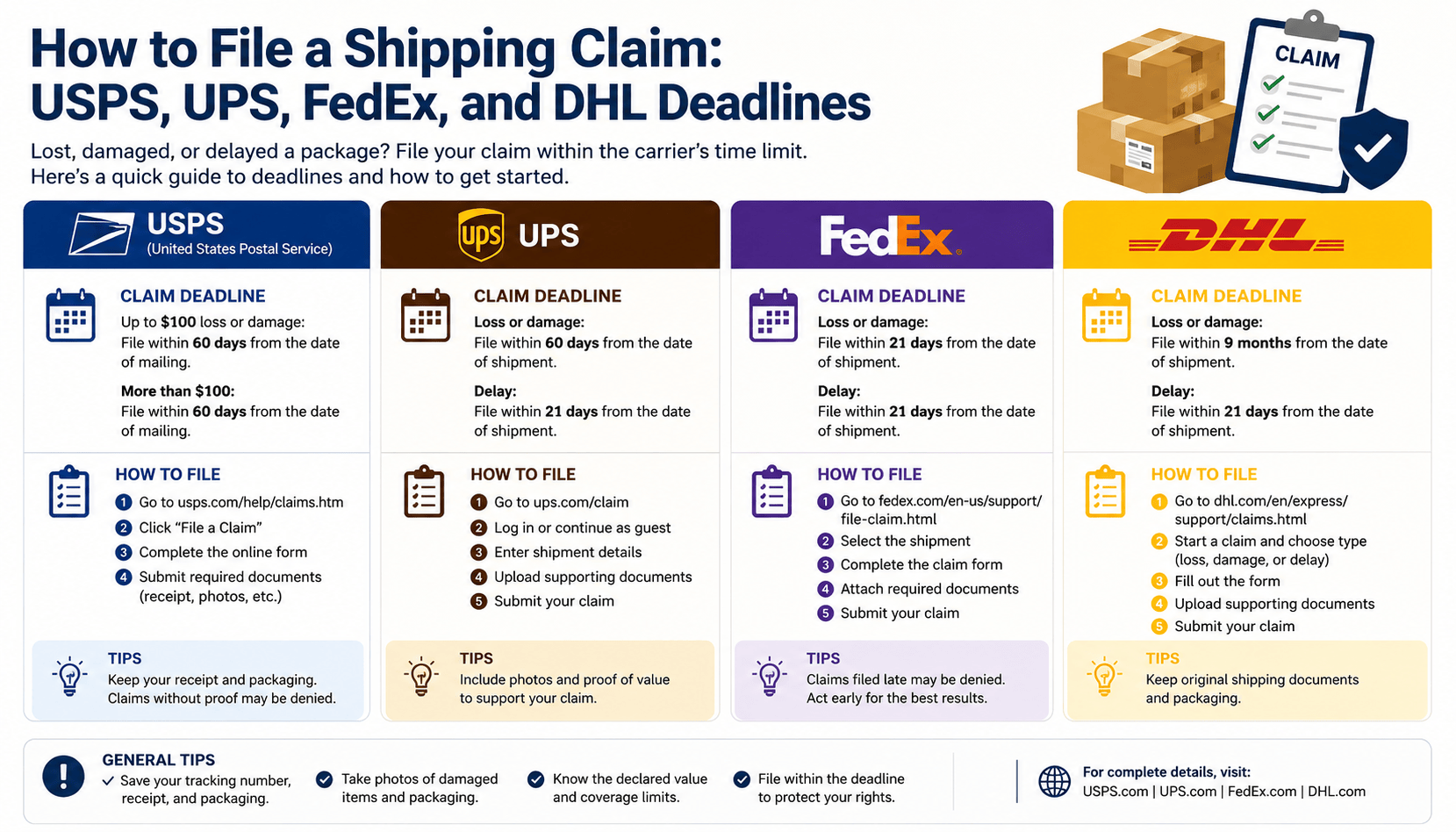
- USPS: file a Help Request Form once the expected delivery date passes, then a Missing Mail Search if it has been 7 days since mailing. The USPS tracking not updating guide walks through both, in order.
- UPS: a missed delivery date or stale scan history is the trigger. The UPS tracking not updating guide covers when a quiet scan is still normal and how to open a trace.
- FedEx: support ticket first for delayed shipments, then a trace or claim. The FedEx tracking not updating guide sorts the scan-gap patterns.
- DHL: which process applies depends on whether it is Express or eCommerce — they are different networks with different rules. The DHL tracking not updating guide explains how to tell and who to contact.
One rule cuts across all four: if a retailer shipped it, the retailer is your claims department. Carriers open investigations and pay claims to the shipper of record, not the recipient. You can and should push the carrier for information, but replacements and refunds come through the seller.
If you are juggling more than one shipment or the carrier’s own page is being vague, running the number through a universal package tracker shows the full scan history across carriers in one place — useful for spotting whether events are being recorded that the retailer’s order page is not showing.
FAQ
How long can a package be stuck in transit before it’s considered lost? There is no universal cutoff, but 7 days without a scan past the delivery estimate is the practical threshold at which carriers accept lost-package searches: USPS opens Missing Mail Searches 7 days after mailing, and UPS, FedEx, and DHL all accept traces well before that point once the delivery date is missed.
My package hasn’t moved in 5 days. Is that normal? For USPS economy mail or DHL eCommerce over a weekend, it is borderline normal. For UPS, FedEx, or any express service, 5 silent days means something is wrong — open a trace now rather than waiting for movement.
Why does my package keep moving back and forth between cities? A mis-sort. The package boarded the wrong truck or plane, and the loops you see are the network routing it back. Annoying, but these packages almost always arrive — typically 2-4 days later than planned.
Does “In Transit” mean it will arrive today? No. In Transit only means the package is somewhere between origin and destination. “Out for Delivery” is the status that means today.
Should I contact the carrier or the seller first? Ask the carrier for status information, but ask the seller for outcomes. If the package is late enough to need a trace or claim, the seller has to file it anyway — looping them in early saves a round trip.